
Tell us about your company and the problem it solves, or its benefit to learners or educators.
Concentric Educational Solutions was founded in Baltimore, Maryland, to solve a problem seen over and over in communities nationwide. A child stops coming to school for reasons nobody quite knows. It could be a housing issue or a sudden lack of transportation. Maybe there’s a health issue nobody’s talking about. Our work began with home visits to students identified as chronically absent because it was the most effective way to identify students in need.

These visits were conducted by members of the local community who were trained to knock on doors, listen to families, and gather firsthand accounts of the real barriers keeping students from school. The data collected during these visits was then brought back to the students’ schools, which gave districts a clear picture of not only who had disengaged from learning, but why. From there, our team would partner with districts to build pathways back to school and opportunity.
But too often, as we went about this work, we found young people’s stories of disconnection were spread across multiple stakeholders. The school knew a piece of that story. The city had another part. And if that same young person had aged out of the system and showed up a few years later as “disconnected,” a workforce board might have a piece, too. Unfortunately, we also found that these organizations, while well-meaning, were not talking to each other, and our youth continued to fall through the cracks between them.
Over the years, we improved our processes for conducting home visits and they remain at the heart of our work. But along the way, we heard from school administrators, municipal leaders, and the heads of foundations that a coordinated way to address youth disconnection was needed. So in response, we built our new digital platform, Concentric360.
Concentric360 gives stakeholders like school systems, municipalities, workforce boards, and community organizations a shared way to identify the causes of youth disconnection and align resources and wraparound supports that remove the barriers to learning, training, and work. Concentric360 takes the same human-centered model for home visits that has proven successful in school and builds around it with tools and resources that offer a coordinated, lasting approach to resolving youth disconnection. Today’s youth have enough things to contend with, and making sure all their advocates are working together to help them succeed should not be on that list.
What is the challenge educators face today that is fixable?
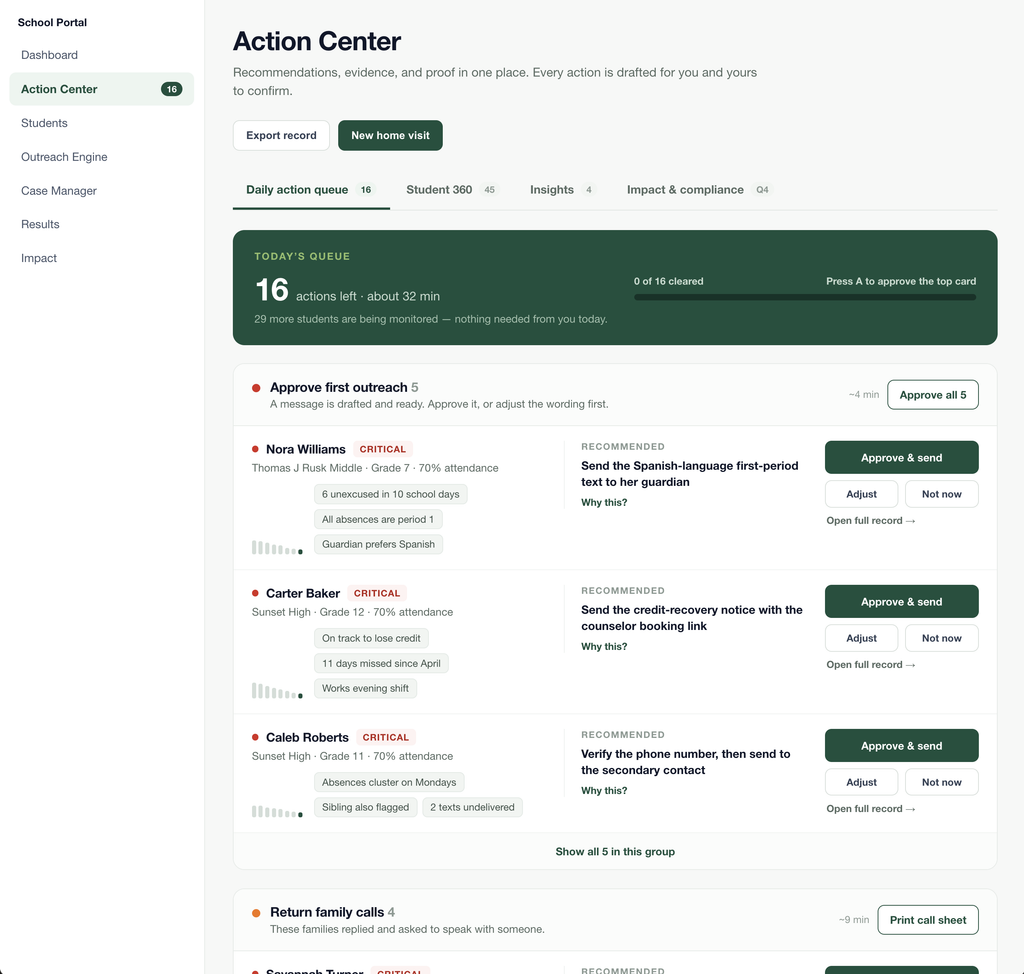
One thing that is concrete and fixable is what I call the “outreach dead end.”
This occurs when a school has sent out its texts, emails, and robo-calls to a chronically absent student and there is no response. The problem could be a wrong number, or that the message was in a language the family does not understand, or the family could have moved and is no longer at that address. But most times, it is not that the family is ignoring the messages. They just aren’t getting them, and that leaves the school with no next move. That is the challenge with relying on automated messaging systems to do the heavy lifting here. They do not provide a next step for escalation.
We know from experience that some students only need a nudge in the form of a text or call or similar communication to return to school and get back on track. For those, automated outreach is a great, low cost solution. But for too many students, a breakdown in trust between school and family and a combination of social, emotional, and environmental factors are making daily attendance difficult or impossible. And a letter or text is not going to fix that.
For those kids, there needs to be another level of outreach, which is where Concentric’s human-centered approach becomes the logical next step. When the automated outreach fails, a trusted member of the community, ready to listen and standing at a family’s front door, can be a difference-maker in the effort to reengage students and families in learning. With the information this individual can bring back to school, a detailed plan can be created that will rebuild trust in institutions and provide the services needed to remove environmental barriers to student reengagement.
This is a step every school can add to its repertoire to make a dent in chronic absenteeism and youth disconnection.
What is the challenge educators face today that will persist?
Staff turnover is the challenge I don’t think will go away in the foreseeable future.
Being an educator has never been harder, and we are seeing that in high rates of staff turnover. The impact of high staff turnover can be felt especially by students drifting toward disconnection. Imagine a child facing serious challenges outside the classroom. Then the teacher, coach, social worker, or counselor they connect with most on a personal level leaves. Students attach their trust to a person, not a school, and when the person moves on, the trust goes with them, which often accelerates disengagement from learning.
Staff turnover also erodes a school’s institutional memory. When someone who knows a family personally leaves, the school loses its understanding of what the family is dealing with, and the relationship between the school and the family resets to zero. And once a family has told their story to one member of their school’s team, it is hard to get them to start from scratch with a new person and retell their story.
Turnover is often highest in the schools with the most disconnection, and in the roles closest to students who are pulling away. Attendance staff, community liaisons, paraprofessionals, and the social workers who do this hard work are all at risk for high turnover, as often the budgets funding those roles are variable and subject to policy and political change.
What are the areas of education or training and workforce development that are being overlooked?
Well, if policymakers and politicians really understood the economic cost of chronic absenteeism and youth disconnection, they would be far more engaged in the issue.
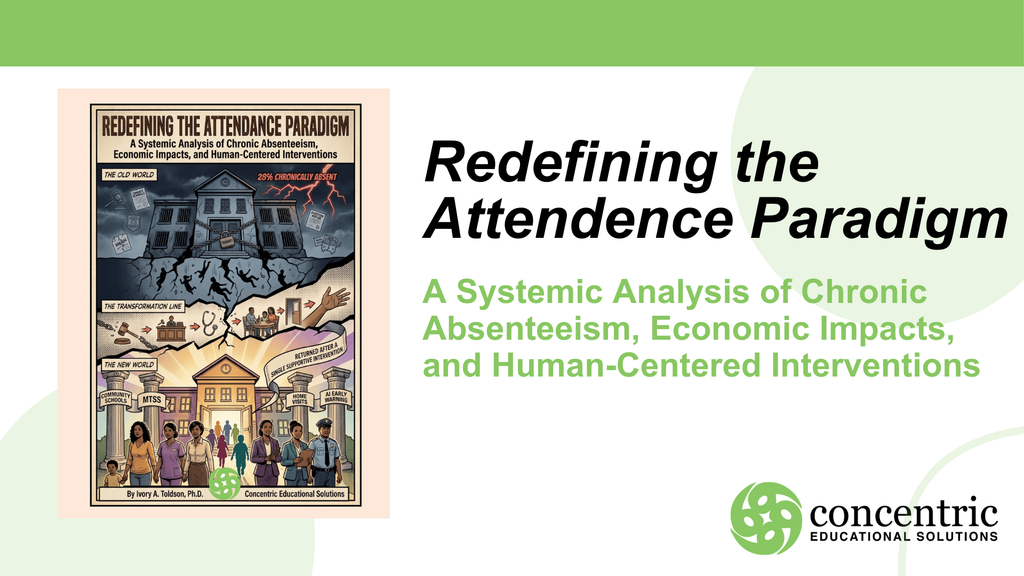
According to a white paper published earlier this year by Concentric Chief of Research Dr. Ivory A. Toldson titled Redefining the Attendance Paradigm: A Systemic Analysis of Chronic Absenteeism, Economic Impacts, and Human-Centered Interventions, chronic absenteeism has hard economic impacts on society.
A chronically absent student’s lost lifetime earnings potential and the strain that puts on families generates a social burden of about $5,630. When chronic absenteeism escalates to suspension or expulsion, the societal costs skyrocket. A suspended student can carry a societal cost of approximately $27,260, and an expelled student’s cost to society balloons to $70,000.
It’s clear from these figures that it is a lot cheaper to address student disconnection as early as possible, and we need to get our policymakers and elected officials to understand this.
What do you foresee will be a challenge in education in three to five years?
I think the funding cliff many school systems are already grappling with today will continue to be problematic well into the future.
With ESSER money gone, school districts that spent a meaningful amount of money on staff such as family liaisons, interventionists, social workers, and counselors are now making cuts to those roles. As I mentioned earlier, these are people who are most closely linked to disconnected youth. Not only do those cuts have an immediate impact on schools, but the loss of one of these positions this year translates to unsupported families in subsequent years.
The funding cliff compounds when shrinking enrollment is factored in. Fewer students enrolled or counted in class means less per-pupil funding, and unfortunately, it is often the districts that are losing enrollment the fastest that are carrying the most students at risk for disconnection. With chronic absenteeism still above pre-pandemic levels, school systems still are being squeezed to do more with less support, just as public concern about the rate of absenteeism is growing.
Some will say that edtech can fill the gaps that the loss of roles critical to fighting chronic absenteeism will create. I came out of the edtech world, and I have seen firsthand edtech’s ability to improve teaching, learning, and school administration. But I have yet to see technology forge the type of trusting relationship an at-risk student needs to keep them at school. As the current funding crisis in schools continues to deepen, education leaders need to work to protect the people and programs that do what technology cannot.