
You’re the translator for the Japanese shogun, and you’ve received a delegation of Catholic priests from Portugal who want to talk to the shogun about converting to the “one true faith.” You know the shogun values your advice, and while you’re deeply offended by the priests’ implication that their beliefs are superior to your own, you’re also conscious of the need to avoid conflict with this European nation. Do you recommend that the priests be expelled from your land? Killed? Or received and humored?
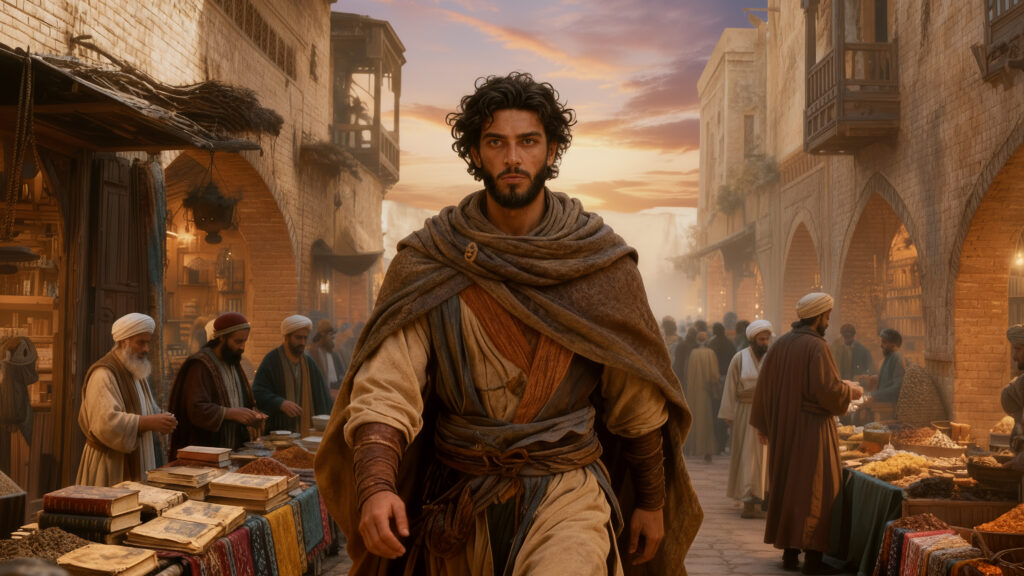
This is the kind of scenario that students are presented with in a series of free digital learning modules created by Northwestern University professor Spencer Striker.
Educators often struggle to hold students’ attention in a world of constant digital distraction. To overcome this challenge, Striker is meeting today’s students where they are: He’s using elements of online gaming, video streaming, immersive reality, and other digital media to engage students deeply in the study of history.
Working with a team of developers and advisors, Striker—a professor of digital media design at Northwestern’s Qatar campus—has developed interactive learning experiences that teach students from middle school through college about world empires, revolutions and industrialization, global pandemics, and other topics.
“It’s about making history seem relevant and interesting to a new generation of learners,” he says of his work.

Striker’s “History Adventures” series of cross-platform learning experiences use interactive, choice-driven narratives featuring fictional characters to help bring history alive for students.
“Learning works better when students feel like they’re inside the problem instead of reading about it from a distance,” he explains. “My projects ask learners to make choices, examine evidence, move through environments, and live with consequences, so that abstract subjects become lived scenarios.”
For instance, Empires & Interconnections (1450 to 1750) is an experience developed for iPads and Android tablets that follows six characters from different regions and social positions as they navigate an era of growing empires and expanding global connection. By reading about these characters and thinking about what they would have done themselves in a similar situation, students learn about issues such as global trade, power, conquest, migration, and cultural exchange.
A student reading about the Black Death in the iPad or web app Black Death Interactive learns something, he explains. But a student assuming the role of a young girl in plague-stricken Venice, deciding whether to flee the city or stay with her dying father, learns this history much more deeply—”in the body.” He adds: “My projects aim to have learners feel the human stakes behind a historical, scientific, or civic problem. The goal is to give teachers experiences memorable enough that students care.”
Other History Adventure modules include:
- Revolutions & Industrialization (1750 to 1900), a cross-platform experience about the human cost and transformative force of revolution and modern industrialization.
- Al-Khwarizmi: Father of Algebra & the Algorithm | An Original Docudrama Series, an animated docudrama created for mobile phones about Al-Khwarizmi, the House of Wisdom, and the Islamic Golden Age of science. Launched on July 15, it uses cinematic storytelling and AI animation to bring the history of science and mathematics to a wide audience, telling the story of the scholar whose name gave us the word “algorithm.”
- Generation Revolution, a prototype special edition set in 1770s New York that explores the dynamics leading to the American Revolution.
Many of Striker’s projects have been funded with federal grant money. To ensure their accuracy, Striker has worked with consulting historians, such as Kieren Johns, a UK-based independent researcher with a Ph.D. in Classics and Ancient History.

“It was my responsibility to add substance to Spencer’s narrative structure,” Johns says.
The results of a pilot project conducted by Northwestern’s Center for Talent Development suggest that Striker’s content helped engage students in the study of history without compromising the rigor of content.
History Adventures content was piloted in two online courses reaching advanced-level high school students. In the courses where the content was used, “we saw higher completion rates for course assignments and an uptick in student participation on class discussion boards,” says Eric Calvert, associate director of the Center for Talent Development.
Incorporating game-like multimedia elements made the content more accessible for some students, Calvert says, adding: “It helped make history less like a timeline and more like the outcome of choices people make.”
Striker has also created a series of digital learning experiences that treat pandemics as human, social, ethical, and historical events, not just biological ones. This content, which includes a virtual reality experience for Meta Quest, Pico, and Windows VR that gives learners a sense of presence inside ancient Athens during the plague, “became especially resonant after COVID-19,” he says, “though its purpose is broader: to help learners see how outbreaks test social trust, ethical judgment, medical knowledge, and human resilience.”
In addition, he has created a free mobile game called Chaos Corp: Troll Farm Simulator, which teaches media literacy by putting players inside a fictional disinformation operation.
“Most media literacy teaches students to spot manipulation from the outside,” he notes. “Chaos Corp lets them feel how it works from the inside, which makes the mechanics concrete and hard to forget.”
Students learn deeply when they engage with compelling stories, hard choices, and meaningful creative tools, Striker argues. He concludes: “What ties these projects together is a single question I keep chasing: What can education become when digital media design, storytelling, game mechanics, and new technology are put in the service of serious learning?”

About the Author
Dennis Pierce
Dennis Pierce is a freelance writer who has been reporting on education for nearly thirty years. He can be reached at denniswpierce@gmail.com.