Katie Henry is Head of North America for the Micro:bit Educational Foundation and is passionate about building partnerships using physical computing to bring innovative learning to young people. A former elementary and middle school STEAM teacher, Katie is a licensed principal and still substitutes in K-12 classrooms today. She is pursuing a Master of Public Management at Carnegie Mellon University, focusing on non-profit and AI management.

Tell us about your company and the problem it solves, or its benefit to learners or educators.
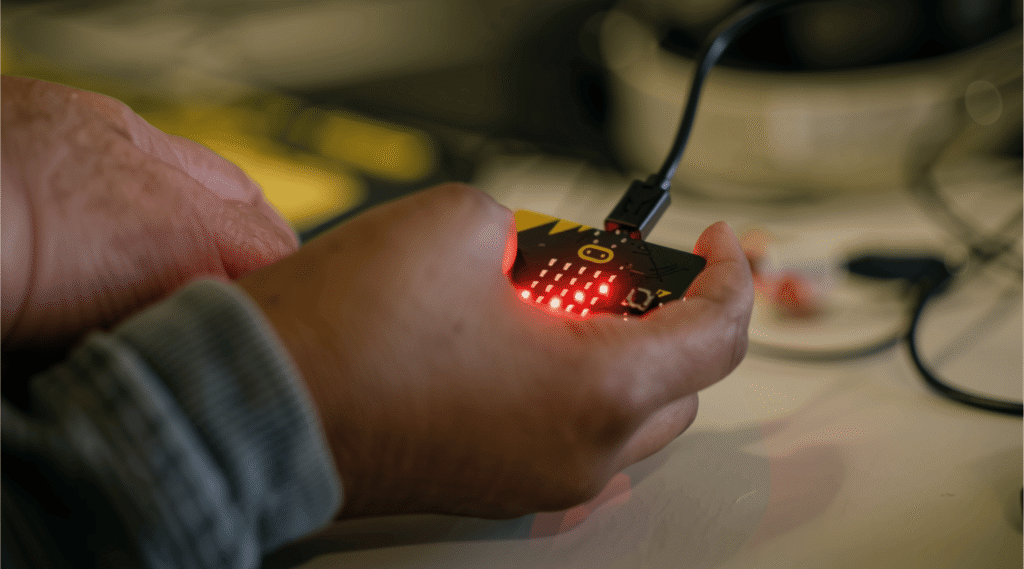
The Micro:bit Educational Foundation believes all young people should have the opportunity to create with technology and build things that matters to them. We are a global non-profit behind the BBC micro:bit, a pocket sized computer that allows young people to combine hardware and software to bring their ideas to life. Whether designing a dog collar to know when a pet is hungry, an artistic display of lights, or an early warning weather alert system, an estimated 73.5 million people worldwide have now learned with the micro:bit across more than 85 countries.
Our role goes beyond the micro:bit itself. We work with educators and partners around the world to remove barriers to computing education and give more young people the skills, confidence and opportunity to become creators with technology.
Whatever an educator’s background, the micro:bit can be used in a wide variety of learning environments to help young people explore their interests and ideas. In science classrooms, young people can collect and analyze data using built in sensors. In art, they can create wearable technology using lights and buttons, and in outdoor education, they can learn about local ecosystems using radio communication between micro:bits. All of this can be done with a single device, powered by young people’s ideas, guided by educators and aligned with learning goals.
A key part of our mission is removing barriers to computing education so that as many young people as possible have the opportunity to participate. That includes making sure young people with different accessibility needs can learn and create with technology alongside their peers.
As a non-profit, the Micro:bit Educational Foundation works with hundreds of partners worldwide to help make that possible and enable organisations to use the micro:bit in ways that work for their communities. From the way the micro:bit is designed, including compatibility with more than 300 accessories, to the way our Foundation works, we are built for collaboration.
We encourage everyone to visit microbit.org to learn more about how to get involved, whether as a partner, educator, translator, developer, reseller, or learner.
What is the challenge educators face today that is fixable?
Educators are incredibly busy, and with packed school schedules it can be difficult to find the time and space to bring young people’s interests, choices and creativity into everyday learning. We hear from educators around the world that time, confidence and the pressure of packed curricula can all be barriers to introducing technology in ways that genuinely enhance learning.
That’s why we design the micro:bit to have a low floor, high ceiling and wide walls. It is easy to get started with, but flexible enough for young people to create a wide range of projects and develop increasingly ambitious ideas as their skills and confidence grow from year to year.
Some classroom tools require significant upfront knowledge and cognitive load, or can become a ‘one-hit wonder’ designed for a single activity. The micro:bit can flex with young people’s needs and grow with them. By choosing tools that work across subjects and age groups, educators and young people can stay focused on what matters most, while having the creativity and flexibility to bring their ideas to life in ways that work for them.
What is the challenge educators face today that will persist?
One challenge I actually think we need to protect is the challenge of learning itself. If learning becomes completely frictionless, there is little opportunity to get curious, try something new, be surprised or even to have hope.
Leaving space for hope means being willing to struggle, to not know the answer and to persist through challenges. As AI tools become increasingly part of our lives, we need to make sure young people have the confidence and agency to use them as creators, not simply consumers. We must protect the productive struggle that is such an important part of learning, while continually provoking our own imaginations to think creatively and move beyond the patterns of the past.
What are the areas of education or training and workforce development that are being overlooked?
Right now, I’m increasingly interested in Public Interest Technology – that’s technology that serves the public good. So many young people, across different generations, want to contribute to work that matters and use their skills to make a difference.
How can we support more young people to develop the collaborative and entrepreneurial skills they need to build their own teams and create their own paths? Non-profits such as Technovation and Project Invent offer free curricula and pathways that combine meaningful design thinking with entrepreneurship, helping young people learn to ‘design with, not for, communities’, as Project Invent puts it.
I’m excited about the future because young people are hungry to be part of work that matters. They aren’t simply accepting the status quo. We need to support them with skills, confidence and opportunities to find their own way, create technology that matters to them and help shape the future they want to see.
What do you foresee will be a challenge in education in three to five years?
In three to five years, I think we’ll see more talented, passionate and values-driven young people venturing into the unknown. Starting their own businesses, launching start-ups and creating new career paths. The challenge will be making sure the right support structures grow with them, including more community education spaces and opportunities for informal, continuing education.
As the nature of assessment shifts and new career pathways open up, those of us in our mid-to-late careers should be asking how we can get involved – not only by mentoring younger generations, but by learning from them too. We might have useful skills and perspectives to share, but they may have a vision for the future that we haven’t even conceived.
As new pathways emerge for young people to demonstrate what they know and what they can do, I think they are going to shine like never before. We need to support them with the skills, confidence and opportunities to shape their own futures, and not be afraid to embrace the possibilities they can see.