

Eric Carmès is an entrepreneur, executive coach and leader with three decades of experience in innovation, business transformation and international growth.
He is the founder and CEO of Encyclo-AI, an EdTech company that helps individuals and businesses learn faster in a world overwhelmed by information.
Eric spent more than twenty years at 6WIND, a French networking software company he co-founded. As COO and later CEO, he led its spin-off from Thales, international expansion across Europe, the United States and Asia, technology partnerships, licensing agreements with the largest telecoms companies and several fundraising rounds involving European and American investors.
As a Partner and Executive Coach at VISCONTI Partners, Eric advised executives leading growing or transforming organizations. Drawing on his entrepreneurial background, he helped leaders strengthen their leadership, refine strategy, engage teams and structure their companies for performance. Eric has also developed expertise in the impact of AI on organizations, business models, corporate culture and the future of work.
Earlier in his career at Thales and Dassault Electronique, Eric held technical, product marketing and business leadership roles in embedded networks, real-time systems and advanced electronics.
Eric holds a degree in networks and telecommunications from CentraleSupélec, a French engineering school.
Tell us about your company and the problem it solves, or its benefit to learners or educators.
Today, information is everywhere.
The internet, social media and AI tools provide access to an unlimited amount of content.
Yet finding information that is reliable, structured and suited to a specific need still takes a great deal of time.
We spend more time searching for, checking and organizing information than actually learning.
AI-enhanced search engines provide answers quickly. However, when we want to explore a topic in greater depth, these answers often remain fragmented and poorly structured.
In just a few minutes, Encyclo-AI transforms the topic of your choice into a Smartbook.
With Encyclo-AI, you get:
- A clear, well-structured, and enjoyable Smartbook
- A reading experience on your computer, smartphone, or e-reader
- An audio version, so you can learn wherever you are
- A document that is easy to keep, annotate, and share
- A low-cost solution for cash-strapped educators looking to maximize their already limited resources
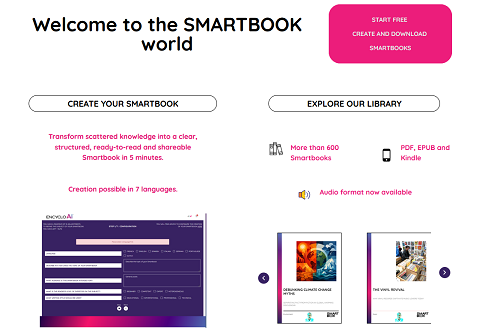
Encyclo-AI lets you spend your time learning instead of searching for information or prompting. Smartbooks can also be a hedge against expensive history books that are often overly broad and not reflecting real-time events and analysis. For example, you can print up specific volumes on topics such as Ghengis Khan that will be way more in-depth than a paragraph in an Asian history book that you have to return at the end of the quarter.
Tell us about your area of expertise and how your knowledge or work enhances the field or the edtech industry.
I have worked as an R&D engineer in the defense and aerospace sectors, as a CEO in the high-tech industry, and as an executive coach.
At every stage of my career, I have had to quickly explore new fields to make informed decisions, collaborate effectively with my teams, support my clients, and quite simply keep pace with a changing world.
When AI emerged, I devoted a great deal of time to understanding how it works and determining how it could tangibly assist me in my daily work.
I immediately realized that it could save a significant amount of time when researching information.
That is how Encyclo-AI was born.
Explain a problem in running an edtech company or selling products or providing service in the space that is related to the work you do?
One of the main challenges for an AI-based edtech company is turning the speed and flexibility of AI into a learning experience that users can trust.
AI can generate large amounts of content very quickly, but speed alone does not create effective learning. Information may be inaccurate, repetitive, poorly organized, or unsuitable for the learner’s actual needs.
The challenge is therefore to combine automation with quality. The content must be clearly structured, sufficiently detailed, easy to understand, and presented in a format that encourages people to continue learning.
There is also a question of trust. Learners and educators need to understand what AI can do well, where its limitations lie, and why human judgment remains essential.
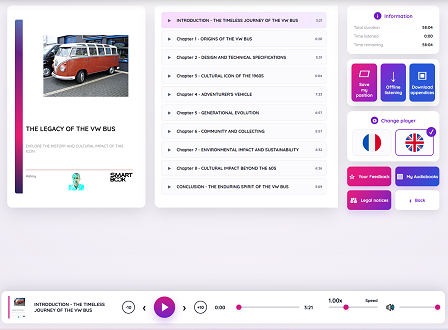
For Encyclo-AI, the central challenge is not simply generating content. It is transforming AI-generated information into a coherent, useful, and enjoyable learning resource.
What are 3-5 specific tips to solving that problem?
- Start with the learner’s real objective. Before introducing any technology, identify what the learner wants to understand, achieve, or apply. Technology should serve that objective rather than determine it.
- Structure the learning journey. A collection of facts is not a learning resource. Content should follow logical progression, introduce the essential concepts first, and help learners gradually explore more complex ideas. This is the concept of concise and progressive Smartbooks. Each Smartbook includes suggestions for further study.
- Build quality controls into the process. AI-generated content should be checked for accuracy, consistency, relevance, clarity, and unnecessary repetition. Sensitive, non-ethical, commercial or rapidly changing subjects require particular attention.
- Combine automation with human judgment and curation. AI is excellent at accelerating research, organizing information, and adapting content. Human expertise is still required to assess meaning, context, and educational value. A Smartbook includes what the learner has requested.
- Help share knowledge. If learners have an excellent user experience, they should be able to share it easily. The joy of sharing knowledge is paramount, which is why any Smartbook you create can be shared without limits.
What other advice do you have for professionals working in edtech?
Do not begin with technology. Begin with a clearly identified learning problem.
New tools appear constantly, particularly in AI. It is tempting to adopt every new feature, but innovation only creates value when it makes learning easier, faster, more accessible, or more effective.
Edtech professionals should also remember that learners have different needs, preferences, levels of knowledge, and amounts of available time. Providing several ways to access the same knowledge through reading, listening, searching, or annotating can make learning much more inclusive and practical.
Finally, remain curious and willing to experiment, but be transparent about the limitations of your technology. Trust will become one of the most important assets in the edtech industry.
The most successful companies will not necessarily be those using the most advanced technology. They will be those that use technology most effectively to help people understand, remember, and apply knowledge.